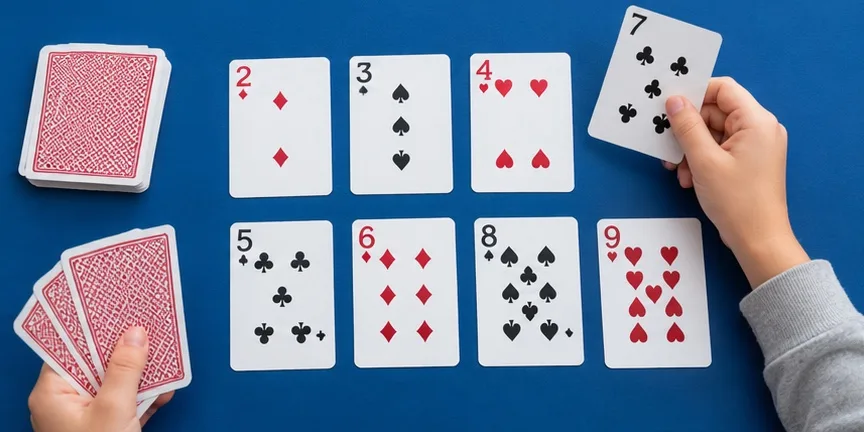
You can practice math facts with a standard deck of cards and no other prep. Take out the cards you don't need, give each card a number value, and play a quick game where kids add, subtract or multiply the cards they turn over. This guide covers five games: Make 10, Addition War, Multiplication War, Salute and Hidden Factor. Each one has the player count, setup, rules, the facts it practices, and an easier and a harder version. Most work for kids around ages 6 to 11.
Set up the deck for your child's level
Every game below uses one of three decks. Set it up before you start so nobody has to stop mid-game to ask what a card is worth.
- Small deck (A–5): Keep only the aces, 2s, 3s, 4s and 5s (20 cards). Ace = 1. Use this for beginners and for sums to 10.
- Beginner deck (A–10): Remove the jacks, queens and kings (40 cards left). Ace = 1, and every other card is worth its number. Use this for sums to 20 and for the 1–10 times tables.
- Times tables deck (A–Q): Remove the kings only (48 cards left). Ace = 1, jack = 11, queen = 12. This covers the full 1–12 times tables.
Taking the kings out avoids confusion, since the jack and queen already cover 11 and 12. Write the values on a sticky note and leave it on the table for the first few games.
Which game practices which facts
| Game | Players | Deck | Facts practiced |
|---|---|---|---|
| Make 10 | 1–2 | A–10 | Pairs that make 10 |
| Addition War | 2 | A–10 | Addition, sums to 20 |
| Multiplication War | 2 | A–10 or A–Q | ×1–10, or ×1–12 |
| Salute (addition) | 3 | A–10 | Missing addend, sums to 20 (links addition and subtraction) |
| Salute (multiplication) | 3 | A–Q | Missing factor, ×1–12 (links multiplication and division) |
| Hidden Factor | 2 | A–10 or A–Q | Missing factor, ×1–10 or ×1–12 |
1. Make 10
Players: 1 or 2
Deck: Beginner deck (A–10)
Facts practiced: The pairs that make 10: 1+9, 2+8, 3+7, 4+6, 5+5
Setup
Shuffle and deal 12 cards face up in three rows of four. Put the rest face down as a draw pile.
Rules
- Look for two face-up cards that add up to 10. A 10 can be taken by itself.
- Say the sum out loud ("3 plus 7 is 10"), take the cards and put them in your pile.
- Fill the empty spots from the draw pile.
- If there is no pair to take, deal one more card face up next to the grid. With two players, your turn ends there.
- With two players, take turns removing one pair at a time. When the draw pile is empty and no pairs are left, the player with more cards wins. Playing alone, try to clear the whole deck.
Because every card in the A–10 deck has a partner, a solo game always clears once all the cards are face up.
Easier and harder
- Easier: Make 5. Use only the aces through 4s (16 cards) and look for pairs that make 5: 1+4 and 2+3.
- Harder: two or three cards. Allow any two or three cards that make 10, such as 2+3+5. The deck may not clear completely this way, so count leftover cards as your score and try to beat it next time.
2. Addition War
Players: 2
Deck: Beginner deck (A–10)
Facts practiced: Addition facts with sums up to 20
Setup
Shuffle and deal all the cards face down, so each player has a pile of 20.
Rules
- Both players flip the top two cards from their pile at the same time.
- Each player adds their own two cards and says the sum out loud.
- The bigger sum wins all four cards. Put them at the bottom of your pile.
- If the sums are equal, each player flips two more cards. The bigger new sum wins all the cards on the table.
- Play until one player has all the cards, or until you stop. Whoever has more cards wins.
Easier and harder
- Easier: Use the small deck (A–5), so every sum is 10 or less.
- Harder: Flip three cards each and add all three, for sums up to 30.
For subtraction, play Subtraction War: flip two cards, take the smaller from the bigger, and the bigger difference wins. With the A–10 deck, every difference is between 0 and 9.
3. Multiplication War
Players: 2
Deck: Beginner deck (A–10) or times tables deck (A–Q)
Facts practiced: Multiplication facts ×1–10, or ×1–12 with jacks and queens in
Setup
Shuffle and deal all the cards face down, evenly between the two players.
Rules
- Both players flip the top two cards from their pile.
- Each player multiplies their own two cards and says the full fact out loud ("6 times 7 is 42").
- The bigger product wins all four cards.
- If the products are equal (for example 3×4 and 2×6), each player flips two more cards. The bigger new product takes everything on the table.
- The player with more cards at the end wins.
Easier and harder
- Easier: one fixed factor. Take out the four cards of one number your child is learning, such as the 2s, and set them aside. Each player flips one card from their pile and multiplies it by that number. Switch to 5s or 10s when the 2s feel easy.
- Harder: Use the times tables deck (A–Q), so jacks (11) and queens (12) come into play and the game covers the full 1–12 tables.
4. Salute
Players: 3 (one caller and two players)
Deck: Beginner deck (A–10) for addition, times tables deck (A–Q) for multiplication
Facts practiced: Missing addends (addition and subtraction) or missing factors (multiplication and division)
Setup
Shuffle the deck. Pick one person to be the caller. An adult can be the caller the first few times.
Rules
- The caller deals one card face down to each of the two players.
- The caller says "Salute!" Both players pick up their card without looking at it and hold it against their forehead, facing out.
- Each player can see the other's card but not their own.
- The caller adds the two cards and says the sum out loud.
- Each player works out their own card from the sum and the card they can see. For example, if the sum is 13 and you see a 5, your card is 8.
- The first player to name their own card correctly wins both cards. If both say it at the same time, each keeps their own card.
- Rotate roles after each round or every few rounds so everyone takes a turn as caller.
Easier and harder
- Easier: Use the small deck (A–5), so the sums stay at 10 or below.
- Harder: Multiplication Salute. Use the times tables deck (A–Q). The caller multiplies the two cards and says the product. Players work out their card by dividing: if the product is 56 and you see a 7, your card is 8.
5. Hidden Factor
Players: 2
Deck: Beginner deck (A–10) or times tables deck (A–Q)
Facts practiced: Missing factors, which is the same as division facts
This is a two-player way to practice missing factors when you don't have a third person for Salute.
Setup
Shuffle and put the deck face down between the players.
Rules
- Player A draws two cards and looks at both.
- Player A puts one card face up and keeps the other face down, then says the product of the two cards out loud. For example, Player A shows a 4 and says "36."
- Player B names the hidden card ("9").
- Player A turns the hidden card over to check. If Player B is right, Player B keeps both cards. If not, Player A keeps them.
- Switch roles and repeat. When the deck runs out, the player with more cards wins.
Both players practice: Player A has to multiply correctly, and Player B checks that the product matches when the hidden card is turned over.
Easier and harder
- Easier: Take out the 2s, 5s and 10s and use them as the face-up card every time. Player A draws one card from this small pile to show and one card from the main deck to hide.
- Harder: Use the times tables deck (A–Q), so the hidden card can be anything from 1 to 12.
A simple routine: play, then check
Card games are a good way to get lots of fact practice in a short session. To see which multiplication facts still need work, add a short check at the end.
- Play a few rounds. Pick one game that matches what your child is working on. Stop while it is still fun.
- Take one short quiz. Afterward, have your child take MathZeal's free times tables quiz (1–12). It doesn't need a sign-up. Watch for the facts they get wrong or hesitate on.
- Aim the next game at the slow facts. If the 7s and 8s were slow, use the one fixed factor version of Multiplication War with the 7s set aside, or play Hidden Factor and always show a 7 or an 8.
The quiz uses the same 1–12 range as the times tables deck, so the facts in the games and the quiz match. For other short daily practice, see the MathZeal homepage.
Tips for smoother games
- Say the whole fact out loud. "6 times 7 is 42" is better than just "42", because the child hears the full fact.
- Let kids check each other. Keep a calculator or an addition or multiplication chart nearby to settle disagreements quickly.
- Change the deck, not the rules. If a game is too hard or too easy, switch decks (A–5, A–10 or A–Q) and keep the rules your child already knows.
- Keep the setup sticky note out. A note that says "A = 1, J = 11, Q = 12, no kings" saves a lot of questions.
FAQ
Do I need a full deck of cards?
No. Most games here use the 40-card beginner deck or a smaller set. A deck with a few missing cards works for practice, but the games will be less even, and in Make 10 some cards may be left without a partner.
What do I do with the kings?
Take them out. With jack = 11 and queen = 12, the deck already covers 1 to 12, and a third face card would only cause confusion.
Which game should we start with?
For addition, start with Make 10 and then Addition War. For multiplication, start with the one fixed factor version of Multiplication War. Salute and Hidden Factor work best once your child knows the facts in one direction and is ready to work backward.
Can these games be used in a classroom?
Yes. Each game needs one deck per pair or group of three. Setting up the decks ahead of time (A–5, A–10 or A–Q) lets groups play at different levels at the same time.