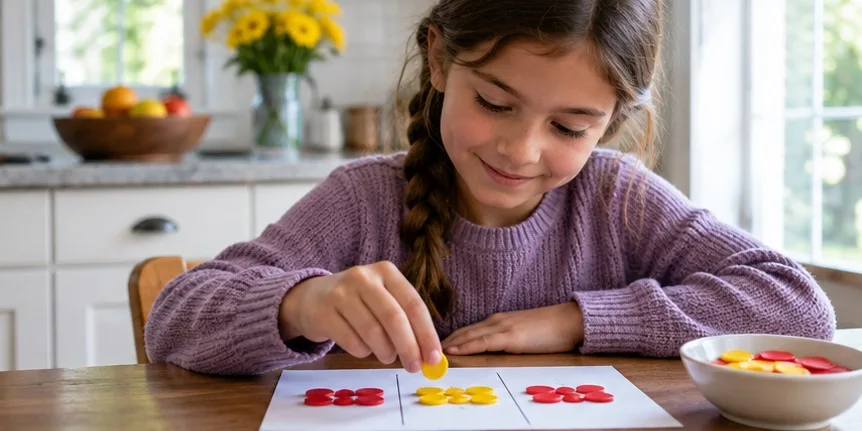
Below are short sets of math problems for kids, sorted by grade and skill. Each set has an answer key directly underneath, with the working shown for anything that needs regrouping or more than one step. The 2nd grade sets cover addition and subtraction within 100, then within 1,000, plus one-step word problems. The 3rd grade sets cover three-digit addition and subtraction with regrouping, multiplication facts and two-step word problems.
The grade labels are a rough guide to when these skills are typically practised in US schools, based loosely on the Common Core State Standards for Mathematics for grades 2 and 3. They are not an official alignment, and your child's school may teach things in a different order. If a set feels too easy or too hard, move to the next or previous one.
How to use these sets
- Print the page or copy one set onto paper. Cover the answer key while your child works.
- Ask your child to write the problems in columns (ones under ones, tens under tens) for anything with two or more digits.
- When checking, look at the working, not just the final number. A wrong answer usually comes from one specific step.
- For subtraction, a quick self-check is to add the answer back to the number taken away. You should get the starting number.
2nd grade math problems
Set 1: Addition and subtraction within 100
What it practises: two-digit addition and subtraction, some with regrouping (carrying and borrowing).
- 34 + 25 =
- 47 + 38 =
- 66 + 27 =
- 78 − 45 =
- 62 − 28 =
- 90 − 36 =
- 53 + 19 =
- 81 − 47 =
Watch for: in 62 − 28, children often do 8 − 2 = 6 in the ones column and get 46. The top digit is smaller, so they need to regroup a ten instead.
Answer key: Set 1
- 59. No regrouping: 4 + 5 = 9 ones, 3 + 2 = 5 tens.
- 85. Ones: 7 + 8 = 15, write 5, carry 1 ten. Tens: 4 + 3 + 1 = 8.
- 93. Ones: 6 + 7 = 13, write 3, carry 1. Tens: 6 + 2 + 1 = 9.
- 33. No regrouping: 8 − 5 = 3 ones, 7 − 4 = 3 tens.
- 34. Ones: 2 is less than 8, so regroup: 6 tens becomes 5 tens, 2 becomes 12. 12 − 8 = 4. Tens: 5 − 2 = 3. Check: 34 + 28 = 62.
- 54. Ones: 0 is less than 6, so regroup: 9 tens becomes 8 tens, 0 becomes 10. 10 − 6 = 4. Tens: 8 − 3 = 5. Check: 54 + 36 = 90.
- 72. Ones: 3 + 9 = 12, write 2, carry 1. Tens: 5 + 1 + 1 = 7.
- 34. Ones: 1 is less than 7, so regroup: 8 tens becomes 7 tens, 1 becomes 11. 11 − 7 = 4. Tens: 7 − 4 = 3. Check: 34 + 47 = 81.
Set 2: Addition and subtraction within 1,000
What it practises: three-digit addition and subtraction, including regrouping across more than one column and subtracting from numbers with zeros.
- 245 + 132 =
- 368 + 457 =
- 509 + 286 =
- 674 − 231 =
- 532 − 178 =
- 600 − 245 =
- 403 − 168 =
Watch for: zeros in the top number, as in 600 − 245 or 403 − 168. There is nothing to borrow from the tens, so the regrouping has to start in the hundreds column.
Answer key: Set 2
- 377. No regrouping: 5 + 2 = 7, 4 + 3 = 7, 2 + 1 = 3.
- 825. Ones: 8 + 7 = 15, write 5, carry 1. Tens: 6 + 5 + 1 = 12, write 2, carry 1. Hundreds: 3 + 4 + 1 = 8.
- 795. Ones: 9 + 6 = 15, write 5, carry 1. Tens: 0 + 8 + 1 = 9. Hundreds: 5 + 2 = 7.
- 443. No regrouping: 4 − 1 = 3, 7 − 3 = 4, 6 − 2 = 4.
- 354. Ones: 2 is less than 8, so regroup a ten: tens go from 3 to 2, ones become 12. 12 − 8 = 4. Tens: 2 is less than 7, so regroup a hundred: hundreds go from 5 to 4, tens become 12. 12 − 7 = 5. Hundreds: 4 − 1 = 3. Check: 354 + 178 = 532.
- 355. Ones: 0 is less than 5 and there are no tens, so regroup a hundred: 6 hundreds becomes 5 hundreds and 10 tens. Then take one of those tens: 9 tens and 10 ones. Ones: 10 − 5 = 5. Tens: 9 − 4 = 5. Hundreds: 5 − 2 = 3. Check: 355 + 245 = 600.
- 235. Ones: 3 is less than 8 and there are no tens, so regroup a hundred: 4 hundreds becomes 3 hundreds and 10 tens. Then take one ten: 9 tens and 13 ones. Ones: 13 − 8 = 5. Tens: 9 − 6 = 3. Hundreds: 3 − 1 = 2. Check: 235 + 168 = 403.
Set 3: One-step word problems
What it practises: reading a short problem, deciding whether to add or subtract, and working it out.
- Maya has 46 stickers. Her friend gives her 27 more. How many stickers does Maya have now?
- A class has 85 pencils. The teacher hands out 39. How many pencils are left?
- A school library has 318 picture books and 145 chapter books. How many books is that altogether?
- Sam's book has 92 pages. He has read 58 pages. How many pages does he have left to read?
- Ben scored 64 points in a game. Ava scored 81 points. How many more points did Ava score than Ben?
Watch for: the word "more" in problem 5. It does not mean add. "How many more" is asking for the difference, so it is a subtraction.
Answer key: Set 3
- 73 stickers. 46 + 27. Ones: 6 + 7 = 13, write 3, carry 1. Tens: 4 + 2 + 1 = 7.
- 46 pencils. 85 − 39. Ones: 5 is less than 9, so regroup: 15 − 9 = 6. Tens: 7 − 3 = 4. Check: 46 + 39 = 85.
- 463 books. 318 + 145. Ones: 8 + 5 = 13, write 3, carry 1. Tens: 1 + 4 + 1 = 6. Hundreds: 3 + 1 = 4.
- 34 pages. 92 − 58. Ones: 2 is less than 8, so regroup: 12 − 8 = 4. Tens: 8 − 5 = 3. Check: 34 + 58 = 92.
- 17 points. 81 − 64. Ones: 1 is less than 4, so regroup: 11 − 4 = 7. Tens: 7 − 6 = 1. Check: 17 + 64 = 81.
3rd grade math problems
Set 4: Three-digit addition and subtraction with regrouping
What it practises: adding and subtracting within 1,000 where most problems need regrouping in two columns.
- 476 + 358 =
- 589 + 267 =
- 645 + 278 =
- 723 − 386 =
- 800 − 437 =
- 912 − 654 =
Watch for: forgetting to add the carried 1 in the next column, or forgetting that a column has already lent a ten. Writing the small carried or regrouped digit above the column helps.
Answer key: Set 4
- 834. Ones: 6 + 8 = 14, write 4, carry 1. Tens: 7 + 5 + 1 = 13, write 3, carry 1. Hundreds: 4 + 3 + 1 = 8.
- 856. Ones: 9 + 7 = 16, write 6, carry 1. Tens: 8 + 6 + 1 = 15, write 5, carry 1. Hundreds: 5 + 2 + 1 = 8.
- 923. Ones: 5 + 8 = 13, write 3, carry 1. Tens: 4 + 7 + 1 = 12, write 2, carry 1. Hundreds: 6 + 2 + 1 = 9.
- 337. Ones: 3 is less than 8, so regroup a ten: tens go from 2 to 1, ones become 13. 13 − 8 = 5. Tens: 1 is less than 8, so regroup a hundred: hundreds go from 7 to 6, tens become 11. 11 − 8 = 3. Hundreds: 6 − 3 = 3. Check: 337 + 386 = 723.
- 363. Regroup from the hundreds: 8 hundreds becomes 7 hundreds, 9 tens and 10 ones. Ones: 10 − 7 = 3. Tens: 9 − 3 = 6. Hundreds: 7 − 4 = 3. Check: 363 + 437 = 800.
- 258. Ones: 2 is less than 4, so regroup a ten: tens go from 1 to 0, ones become 12. 12 − 4 = 8. Tens: 0 is less than 5, so regroup a hundred: hundreds go from 9 to 8, tens become 10. 10 − 5 = 5. Hundreds: 8 − 6 = 2. Check: 258 + 654 = 912.
Set 5: Multiplication facts
What it practises: single-digit multiplication facts, plus two equal-groups problems that show what multiplication means.
- 3 × 4 =
- 5 × 6 =
- 2 × 9 =
- 4 × 7 =
- 6 × 8 =
- 7 × 9 =
- 8 × 3 =
- 9 × 6 =
- There are 4 bags with 5 apples in each bag. How many apples are there?
- A hall has 6 rows of chairs with 7 chairs in each row. How many chairs are there?
Watch for: adding instead of multiplying, such as writing 3 × 4 = 7. If that happens, draw 3 groups of 4 dots and count them.
Answer key: Set 5
| Problem | Answer |
|---|---|
| 1. 3 × 4 | 12 |
| 2. 5 × 6 | 30 |
| 3. 2 × 9 | 18 |
| 4. 4 × 7 | 28 |
| 5. 6 × 8 | 48 |
| 6. 7 × 9 | 63 |
| 7. 8 × 3 | 24 |
| 8. 9 × 6 | 54 |
| 9. 4 bags of 5 apples | 4 × 5 = 20 apples |
| 10. 6 rows of 7 chairs | 6 × 7 = 42 chairs |
Multiplication facts take repetition. To drill facts from 1 to 12 without signing up, use our free times tables quiz. Times tables are the only interactive practice MathZeal has at the moment; the addition, subtraction and word problems on this page are for working on paper.
Set 6: Two-step word problems
What it practises: problems that need two calculations, mixing addition, subtraction and multiplication.
- A baker makes 6 trays of muffins with 5 muffins on each tray. He sells 18 muffins. How many muffins are left?
- Jo has $45. She spends $18 on a book and $12 on a game. How much money does she have left?
- A school has 236 children in the morning group and 187 in the afternoon group. 150 of them go on a trip. How many children do not go on the trip?
- Dad buys 4 packs of juice boxes with 6 boxes in each pack. 9 children each drink one box. How many juice boxes are left?
- Tom reads 8 pages every day for 7 days. His book has 100 pages. How many pages does he still have to read?
Watch for: stopping after the first step. In problem 1, 30 is the number of muffins baked, not the answer. Ask your child to reread the question once they have a number.
Answer key: Set 6
- 12 muffins. Step 1: 6 × 5 = 30 muffins baked. Step 2: 30 − 18 = 12 left.
- $15. Step 1: 18 + 12 = 30 spent. Step 2: 45 − 30 = 15 left. (Or 45 − 18 = 27, then 27 − 12 = 15.)
- 273 children. Step 1: 236 + 187. Ones: 6 + 7 = 13, write 3, carry 1. Tens: 3 + 8 + 1 = 12, write 2, carry 1. Hundreds: 2 + 1 + 1 = 4. Total 423. Step 2: 423 − 150. Ones: 3 − 0 = 3. Tens: 2 is less than 5, so regroup a hundred: 12 − 5 = 7. Hundreds: 3 − 1 = 2. Answer 273. Check: 273 + 150 = 423.
- 15 juice boxes. Step 1: 4 × 6 = 24 boxes. Step 2: 24 − 9 = 15 left.
- 44 pages. Step 1: 8 × 7 = 56 pages read. Step 2: 100 − 56. Regroup from the hundreds: 9 tens and 10 ones. Ones: 10 − 6 = 4. Tens: 9 − 5 = 4. Answer 44. Check: 44 + 56 = 100.
Where to go next
If your child is comfortable with Set 4 and most of Set 5, the next step is usually getting multiplication facts quick and automatic. The times tables quiz covers 1 to 12. For more, see MathZeal's free daily practice.